
Home > Blog > Ferrari Model Showcase > Ferrari F50: Specs, Price, & The Last Halo Car You Shift Yourself
Share this post:
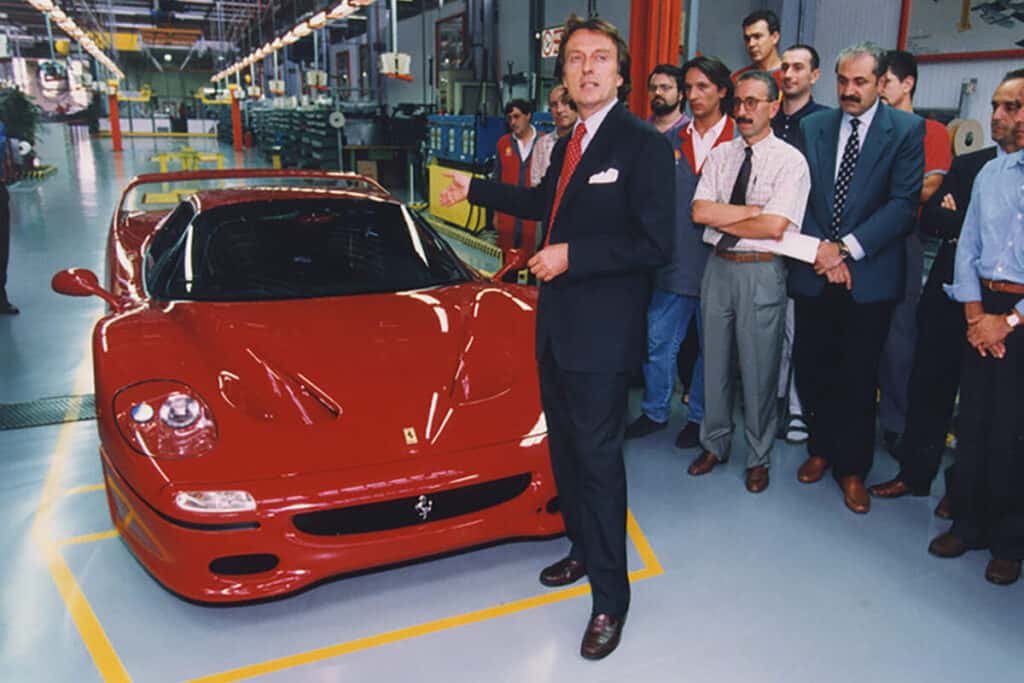
The Ferrari F50 is a limited-production Ferrari supercar introduced in 1995 at the Geneva International Motor Show to celebrate Ferrari’s 50th anniversary. Powered by a naturally aspirated V12 derived from Ferrari’s Formula 1 program, the F50 combined open-air driving with race-inspired engineering and analog performance.
It is the third car in Ferrari’s halo lineage, following the 288 GTO and F40, and preceding the Enzo, LaFerrari, and F80.
The F50 delivers performance through simplicity — a high-revving V12 bolted directly to a carbon-fiber tub, with almost nothing between the driver and the mechanism.
| Category | Specification |
|---|---|
| Engine | 4.7L Naturally Aspirated V12 |
| Horsepower | 512 hp @ 8,500 RPM |
| Torque | 347 lb-ft |
| Transmission | 6-Speed Gated Manual |
| 0–60 mph | ~3.7 seconds |
| Top Speed | 202 mph |
| Fiorano Lap | 1:27.0 |
| Dry Weight | 2,712 lb (1,230 kg) |
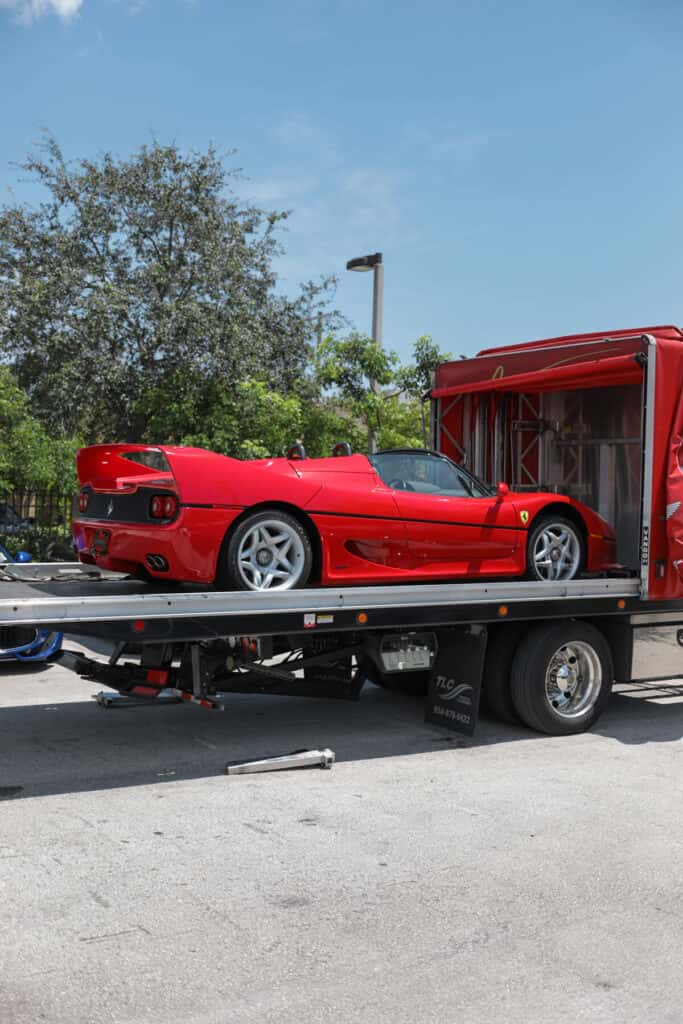
The F50 rarely reaches the open market — only 349 were built. Our specialists can help with sourcing inquiries.
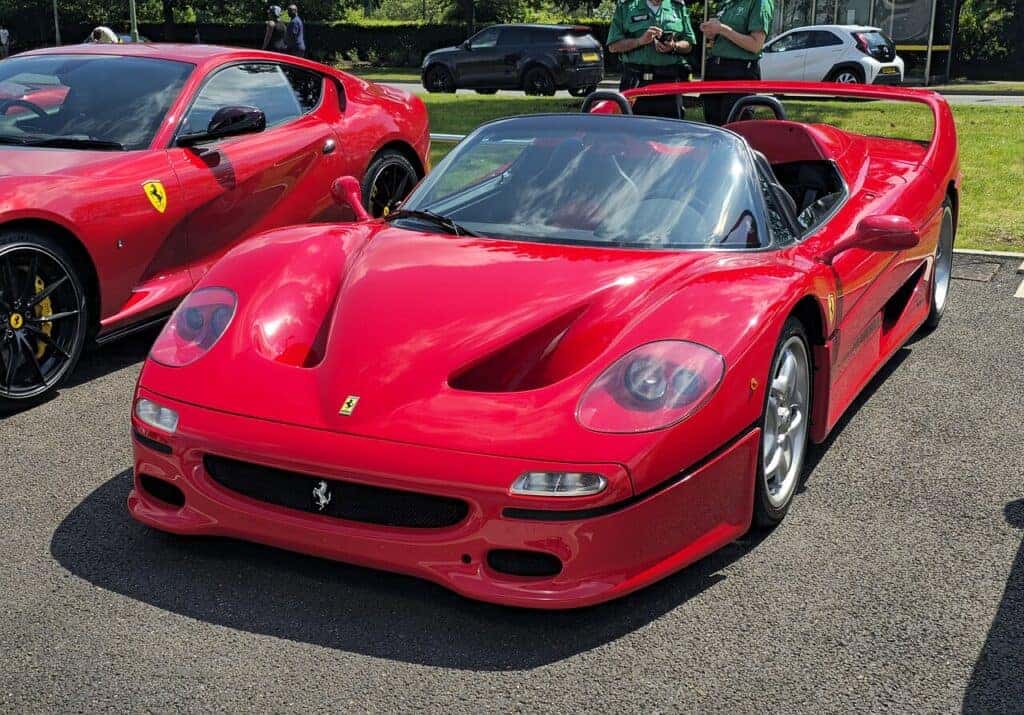
The Ferrari F50’s V12 came from Ferrari’s 1990 Formula 1 program — a 3.5-liter race engine enlarged to 4.7 liters for the road. It is the closest thing to an F1 engine Ferrari has ever sold.
The F50 was also Ferrari’s first road car built around a full carbon-fiber monocoque — construction borrowed from Formula 1 that cut weight while increasing rigidity. Bolting the engine straight to that tub means you feel everything it does.
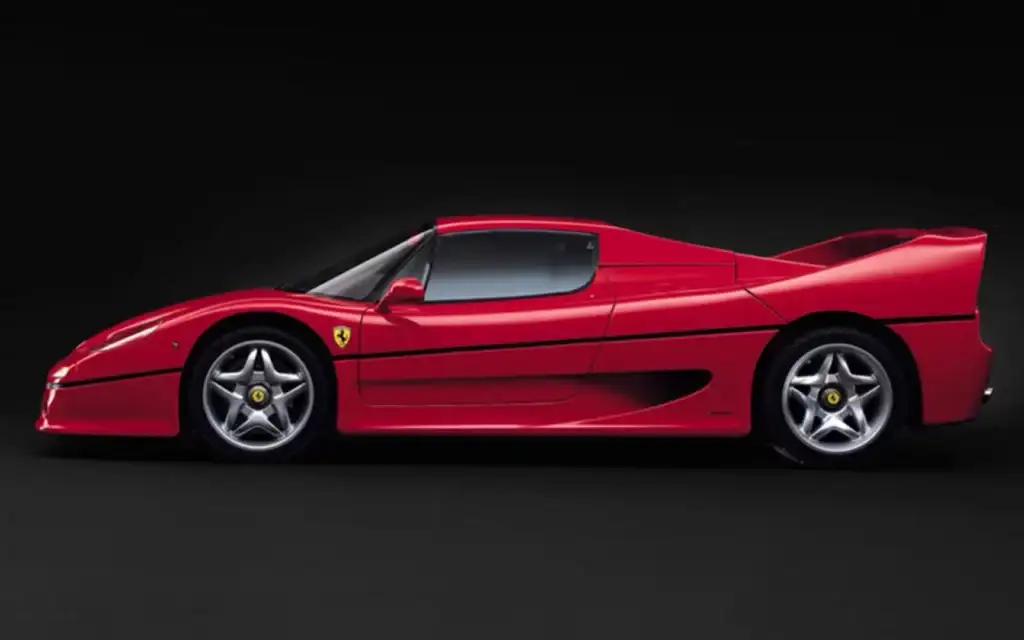
Pininfarina designed the F50 under Pietro Camardella and Lorenzo Ramaciotti, softening the F40’s hard edges into something shaped more by airflow than aggression.
Almost nothing on the body is decorative. The shape came out of airflow work, not a styling brief.
Ferrari removed everything that did not make the car faster.
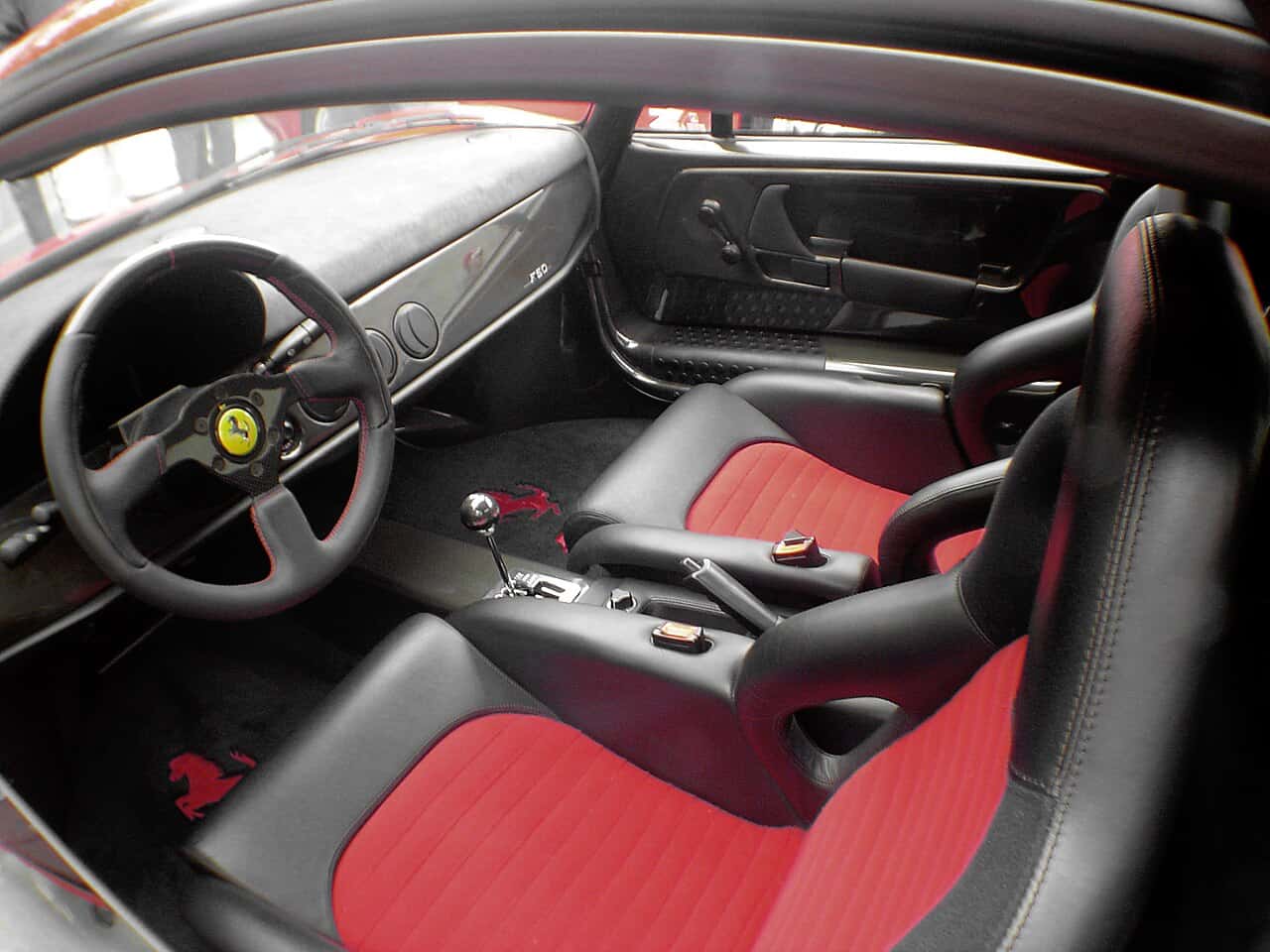
Ferrari built exactly 349 F50 road cars between 1995 and 1997 — a deliberate cap set to protect long-term exclusivity. Three additional F50 GT chassis were built separately for a racing program that never ran.
| Variant | Details |
|---|---|
| European-Spec | 294 road cars |
| US-Spec | 55 road cars, lease-only |
| Road Car Total | 349 |
| F50 GT | 3 track-only chassis, built separately |
| Prototype | Chassis #99999 |
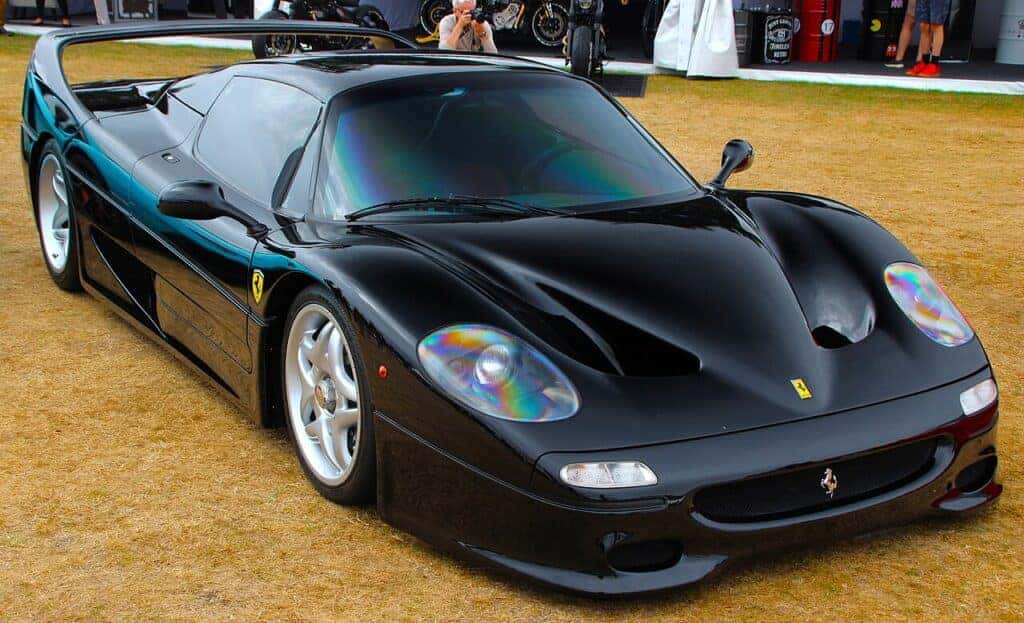
The F50 GT was built to beat the McLaren F1 GTR and Porsche 911 GT1 in BPR/FIA GT1 racing. It never turned a wheel in competition.
Ferrari canceled the programme to concentrate resources on Formula 1, and the three completed chassis were sold to collectors on the condition they were never raced. They remain the rarest F50s by a wide margin — three cars against 349.
The next time Ferrari built a flagship around race-derived technology, it was the Enzo.
Chassis #99999 — the last five-digit Ferrari chassis number ever issued — served as the F50’s original prototype and global launch vehicle.
Personally promised by Enzo Ferrari to Jacques Swaters, it was tested by Ferrari F1 drivers, displayed at the 1995 Geneva Motor Show, and used for early magazine photography. Today, it remains one of the most important F50s ever built.
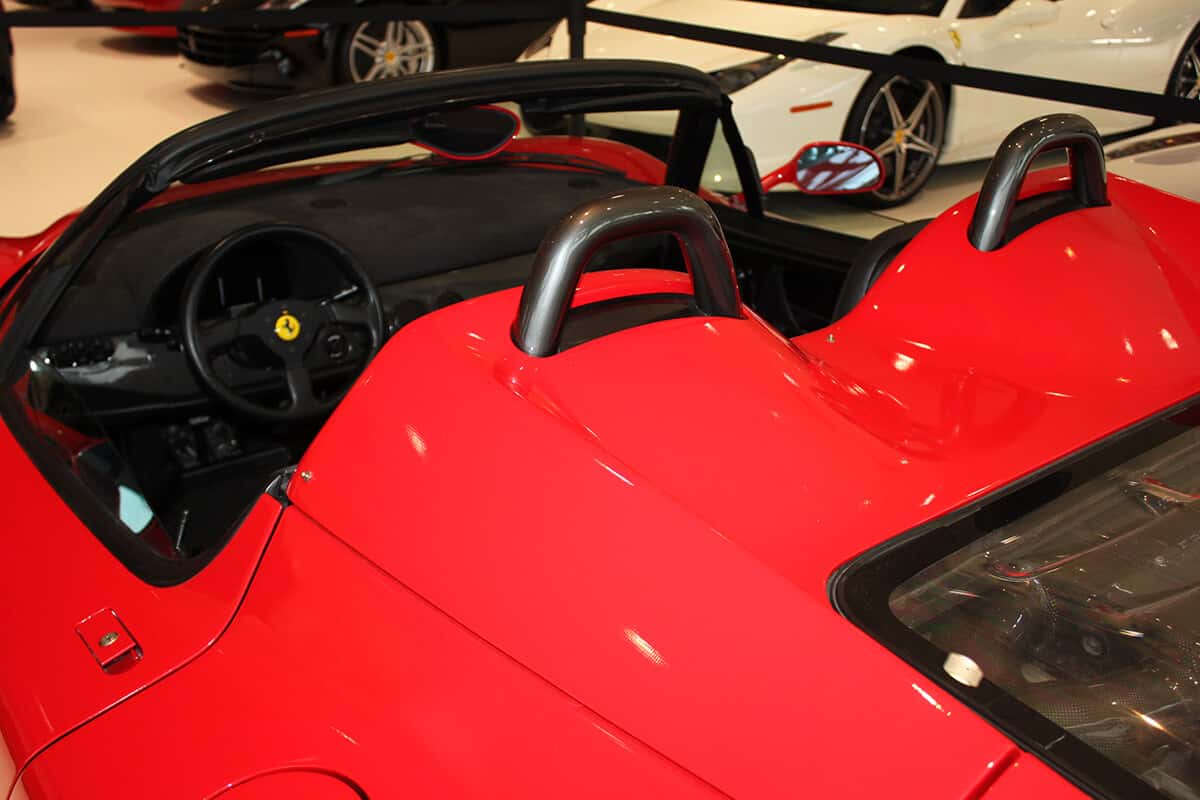
This model spent two decades as the overlooked middle child between the F40 and the Enzo.
That ended. Manual gearboxes and naturally aspirated V12s are now the two things collectors pay most for, and the F50 is the only Ferrari flagship with both.
| Category | Value |
|---|---|
| Original MSRP (1995, US) | ~$475,000 – $487,000 |
| Typical Market Range (2026) | ~$6,000,000 – $9,200,000 |
| Exceptional Examples | ~$9,200,000 – $12,200,000 |
Public Auction Record
$12,210,000
A Rosso Corsa 1995 F50 showing 252 miles, sold from the Phil Bachman Collection at Mecum Kissimmee in January 2026. Ferrari Classiche certified, previously owned by golfer Ian Poulter, and one of the 55 US-spec cars.
It took the record from the previous Monterey benchmark of $9,245,000, set six months earlier. Only seven F50s have ever passed $6 million at public auction, and three of those sold in January 2026.
If you own an F50 or another collector Ferrari, our specialists can value your car or discuss consignment.
At launch, Ferrari North America wouldn’t sell the 55 US cars outright. After watching speculators flip F40s, it offered a lease instead — $240,000 down, $5,600 a month for a mandatory 24 months, and a $150,000 buyout to take the title. $524,400 in total.
Cars you couldn’t buy for half a million in 1995 now trade for over ten times that.
The F50 sits between two very different ideas of what a Ferrari flagship should be. The F40 before it made its power with turbochargers. The Enzo after it made its lap times with electronics.
| Feature | Ferrari F40 (1987–1992) | Ferrari F50 (1995–1997) | Ferrari Enzo (2002–2004) |
|---|---|---|---|
| Engine | 2.9L Twin-Turbo V8 | 4.7L Naturally Aspirated V12 | 6.0L Naturally Aspirated V12 |
| Horsepower | 471 hp | 512 hp | 651 hp |
| Torque | 426 lb-ft | 347 lb-ft | ~485 lb-ft |
| Transmission | 5-Speed Manual | 6-Speed Gated Manual | 6-Speed Automated Manual |
| 0–60 mph | ~4.1 sec | ~3.7 sec | ~3.3 sec |
| Top Speed | 201 mph | 202 mph | 217 mph |
| Fiorano Lap | 1:29.6 | 1:27.0 | 1:24.9 |
| Production | 1,311 Units | 349 Units | 400 Units |
Scroll for more →
Note what the F50 gave up. It has less torque than the F40 and less of everything than the Enzo. What it has instead is the only combination of a naturally aspirated V12 and a gated manual in the entire six-car lineage — which is precisely why it now costs more than the Enzo.
Most F50s trade between $5.8 million and $9.1 million, with exceptional examples above $9.2 million. Value depends on mileage, original paint, and Ferrari Classiche documentation. US-spec cars carry a premium because only 55 were built.
349 road cars between 1995 and 1997 — 294 European-spec and 55 US-spec — plus three separate F50 GT racing chassis.
The F50 uses a 512-hp naturally aspirated V12 with a gated manual gearbox. The Enzo makes 651 hp and shifts through an automated manual with paddles. The Enzo is quicker in every measurable way, but the F50 is the last flagship Ferrari built for a driver who wanted to do the work.
Yes. The F50 was designed as a barchetta with a removable hardtop, so it works as both an open car and a coupe. Ferrari supplied a dedicated flight case for the conversion hardware.
The Ferrari F50 was once overshadowed by the F40 and Enzo, but collectors now appreciate its analog driving experience and direct Formula 1 connection.
Every Ferrari F50 came equipped with a 6-speed gated manual transmission.
The F50 GT. Ferrari built only three complete chassis for a 1996 GT1 racing program that was canceled before it ever competed, making the GT far rarer than any of the 349 road cars.
Not initially. Ferrari North America leased the 56 US cars rather than selling them — $240,000 down, $5,600 a month for 24 months, and a $150,000 buyout to take title. The structure existed to stop the speculation that had followed the F40.
Collectors value the Ferrari F50 for its naturally aspirated V12, manual transmission, low production numbers, and Formula 1-inspired engineering.
The F50 is the last of the analog flagships.
From 1960s competition berlinettas to the latest hybrid flagships, our model showcase covers the cars that built the marque.
Only 349 were built, and the 55 US cars were leased rather than sold when new. Official Ferrari Dealer and Classiche-authorized workshop, serving collectors nationwide.