
Home > Blog > Ferrari Model Showcase > Ferrari Enzo: Specs, Value & Formula 1 Technology
Share this post:
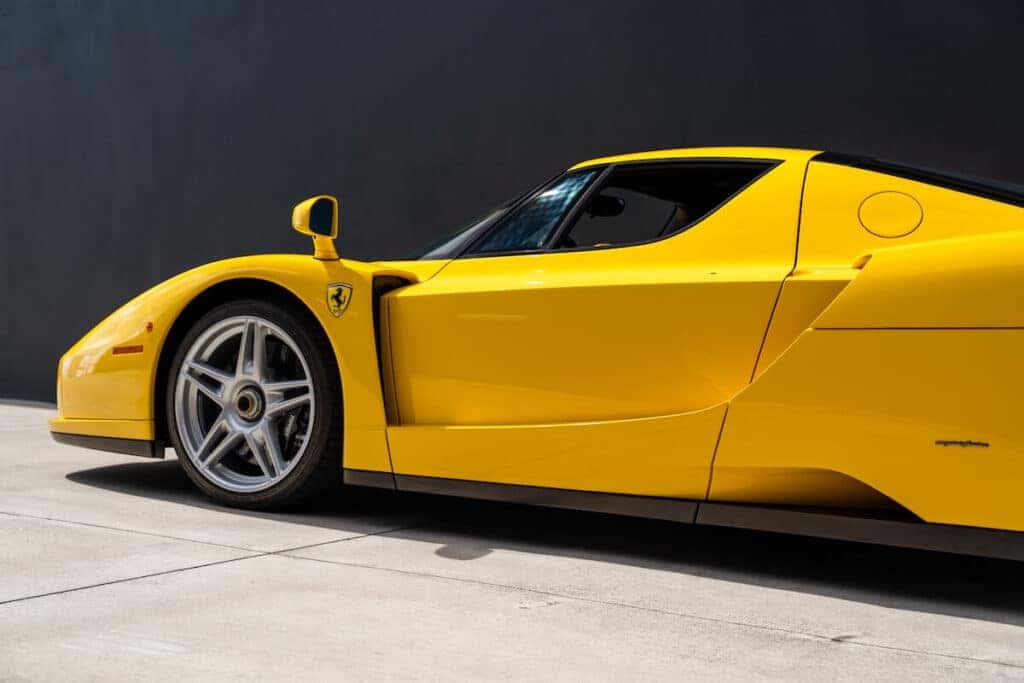
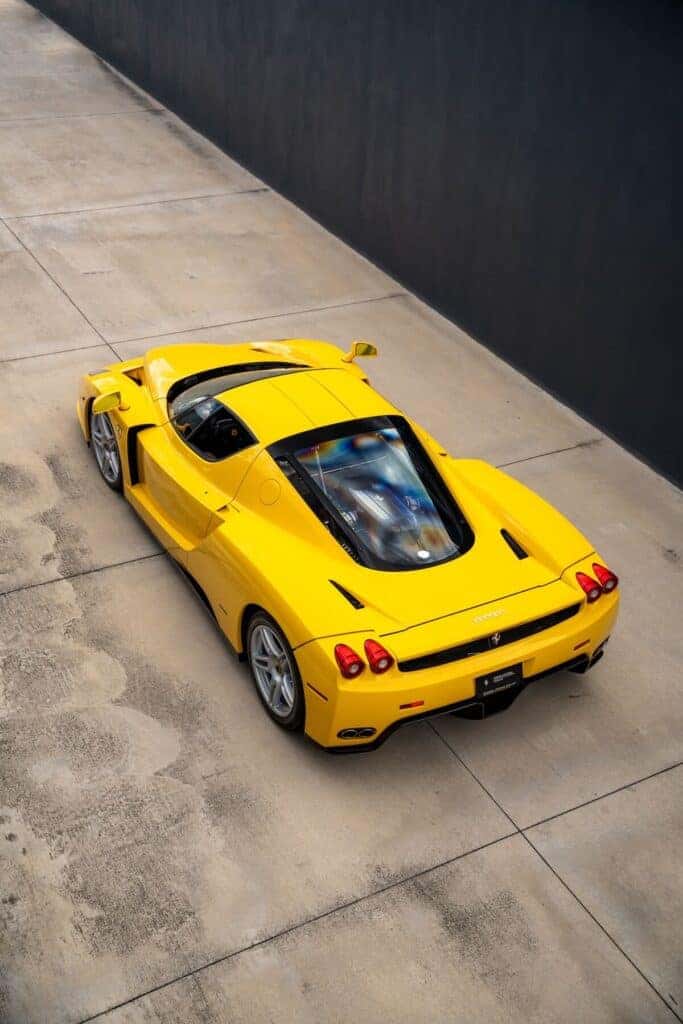
The Ferrari Enzo is a limited-production hypercar built from 2002 to 2004, named after founder Enzo Ferrari. It introduced a composite chassis, paddle-shift transmission, and a naturally aspirated 6.0-liter V12 producing 651 horsepower.
It is the fourth car in Ferrari’s Big 6 lineage, after the 288 GTO, F40, and F50, and before the LaFerrari and F80.
The Enzo paired naturally aspirated V12 power with engineering developed during Ferrari’s dominant early-2000s motorsport era. At launch it was the fastest production Ferrari ever built, and its 217 mph ceiling stood unbeaten by its own successor.
| Category | Specification |
|---|---|
| Engine | 6.0L Naturally Aspirated V12 |
| Horsepower | 651 hp @ 7,800 RPM |
| Torque | 485 lb-ft @ 5,500 RPM |
| Transmission | 6-Speed F1 Automated Manual |
| 0–60 mph | 3.3 seconds |
| Top Speed | 217 mph |
| Fiorano Lap | 1:24.9 |
| Curb Weight | 3,009 lb (1,365 kg) |
The Enzo rarely reaches the open market — only 400 were built, and Ferrari chose every original buyer by invitation. Our specialists can help with sourcing inquiries.
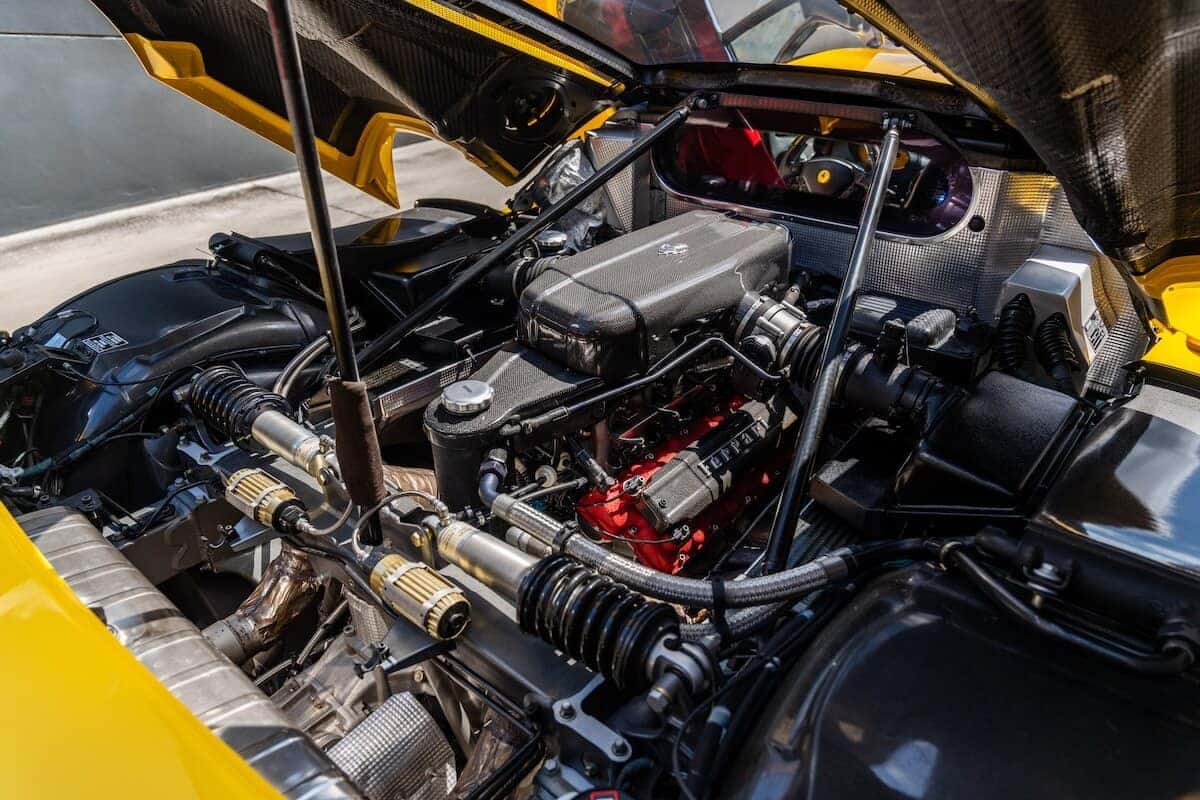
The Enzo is where Ferrari’s Formula 1 program stopped influencing road cars and started supplying them.
Michael Schumacher helped refine the car during Fiorano testing. More than any single component, the Enzo is the point where a Ferrari flagship became an electronically managed machine rather than a mechanical one with electronic help.
Almost every line on the Enzo answers to airflow rather than styling. That’s why it divided opinion at launch and still does.
The Enzo is the first Ferrari flagship where downforce is managed rather than fixed.
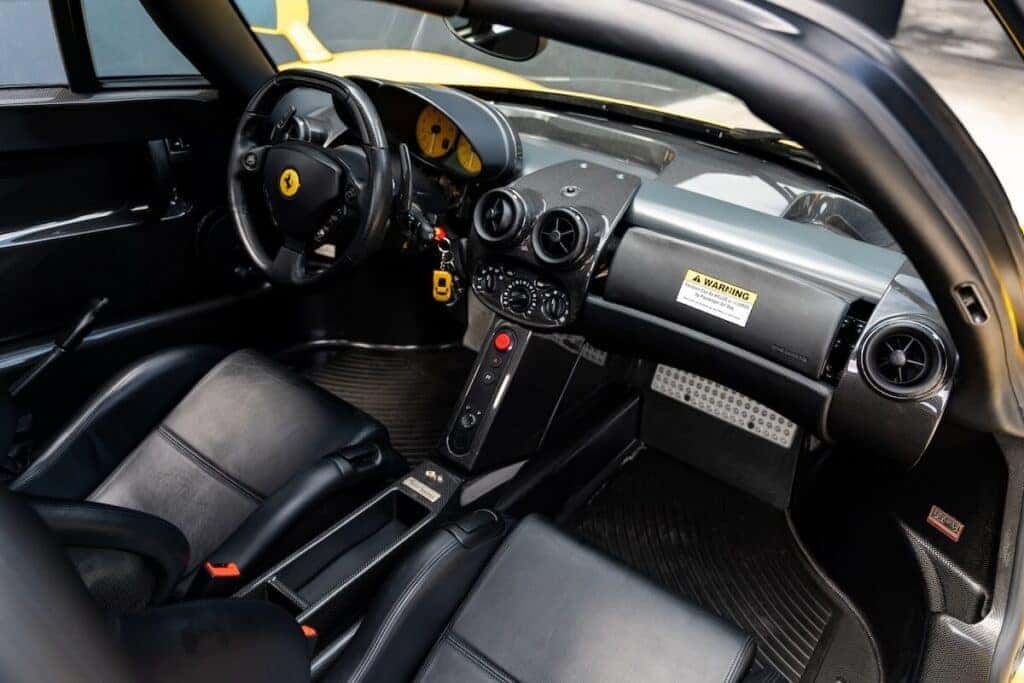
The cockpit is where the Formula 1 influence is least subtle.
Ferrari officially produced 400 Enzos between 2002 and 2004, making it one of the rarest modern Ferrari halo cars.
| Variant | Units Produced |
|---|---|
| Standard Ferrari Enzo | 399 |
| 400th “Pope John Paul II” Enzo | 1 |
| Official Production Total | 400 |
Ferrari built one final Enzo beyond the original 399-car run as a gift for Pope John Paul II in 2005, complete with a handwritten dedication from Chairman Luca di Montezemolo beneath the front lid.
The car was later auctioned to support victims of the 2004 Indian Ocean tsunami — cementing its place as one of the most historically significant Enzos ever built.
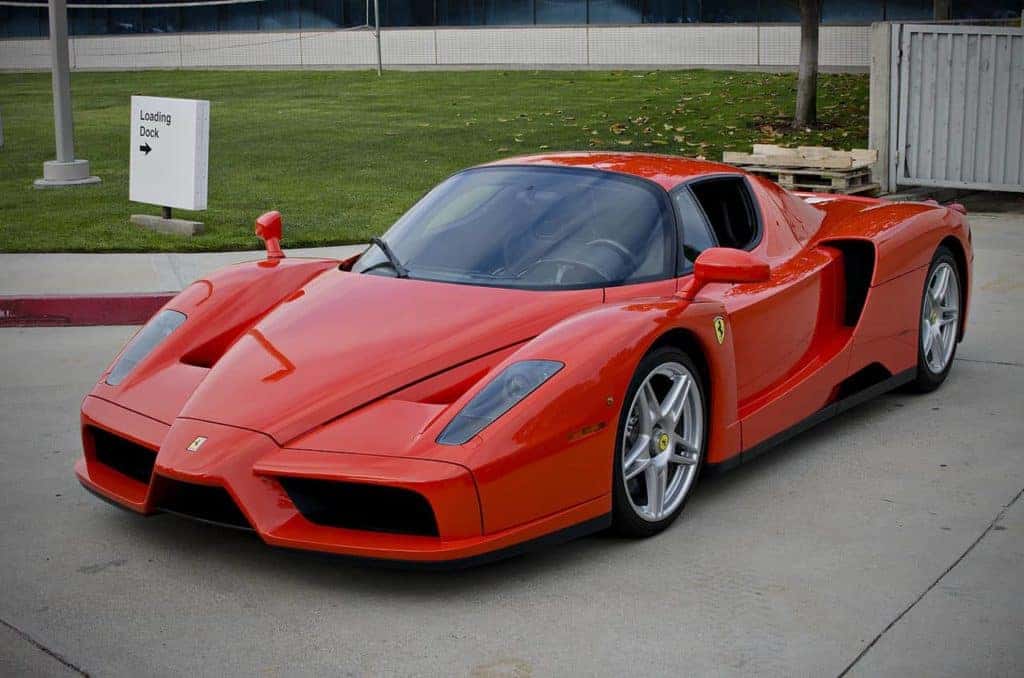
The Enzo didn’t end at 400 cars. Its carbon tub and V12 went on to underpin two very different machines.
The FXX is the track-only Enzo that launched Ferrari’s XX programme — the arrangement where Ferrari owns the experience rather than the customer owning the car.
Michael Schumacher’s all-black car was chassis 30. FXXs now trade at roughly €3.5 to €5.5 million, with Evoluzione cars higher — a public record of €4.45 million at Gooding in 2026. The programme continues today through the FXX K and FXX K Evo.
Ferrari owned Maserati at the time, and the MC12 is an Enzo underneath — same carbon tub, same V12, detuned to 630 hp.
The racing programme it existed to enable won multiple FIA GT championships. It is the only case of a Ferrari halo car’s architecture being handed to another marque.
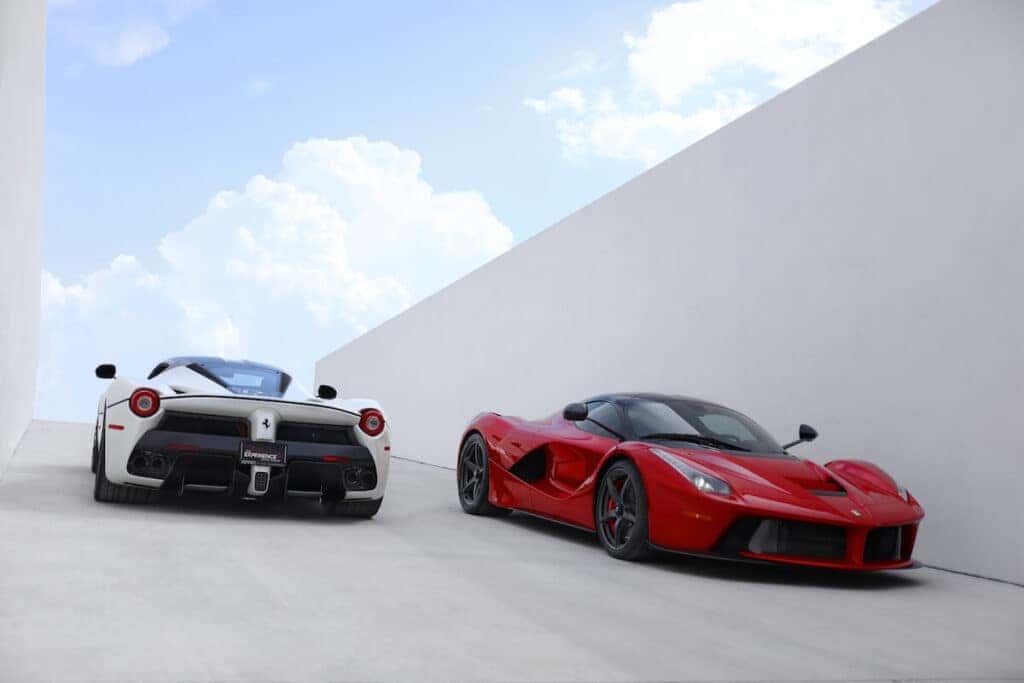
The Enzo repriced faster than any modern Ferrari. Five sold in 2023 and 2024, all between $4 million and $4.5 million. Then five sold in the first quarter of 2026 alone, averaging $12.7 million.
Nothing about the car changed. Supply did — few Enzos came to market in 2025, and when the Bachman collection tested it in January, the result reset the model.
| Category | Value |
|---|---|
| Original MSRP (2002) | ~$659,430 |
| Typical Market Range (2026) | ~$7,700,000 – $12,000,000 |
| Exceptional Examples | ~$15,000,000 – $17,900,000 |
World Auction Record
$17,875,000
A 649-mile Giallo Modena Enzo from the Phil Bachman Collection, sold at Mecum Kissimmee in January 2026. The previous public auction record had stood at $6,050,000 since 2015 — the Pope's Enzo at RM Sotheby's Monterey.
The one-of-one Rosso Dino Enzo made $11,110,000 at the same auction, then $13,018,950 online through duPont REGISTRY Live in June 2026.
If you own an Enzo or another collector Ferrari, our specialists can value your car or discuss consignment.
The Enzo sits between two very different ideas of what a Ferrari flagship should be. The F50 before it was the last one you shifted yourself. The LaFerrari after it was the first with an electric motor.
| Feature | Ferrari F50 (1995–1997) | Ferrari Enzo (2002–2004) | Ferrari LaFerrari (2013–2016) |
|---|---|---|---|
| Engine | 4.7L Naturally Aspirated V12 | 6.0L Naturally Aspirated V12 | 6.3L Naturally Aspirated Hybrid V12 |
| Horsepower | 512 hp | 651 hp | 950 hp |
| Torque | 347 lb-ft | ~485 lb-ft | ~664 lb-ft |
| Transmission | 6-Speed Gated Manual | 6-Speed Automated Manual | 7-Speed Dual-Clutch |
| 0–60 mph | ~3.7 sec | ~3.3 sec | ~2.4 sec |
| Top Speed | 202 mph | 217 mph | 217+ mph |
| Fiorano Lap | 1:27.0 | 1:24.9 | 1:19.7 |
| Production | 349 Units | 400 Units | 710 Units |
Scroll for more →
Read the transmission row before the horsepower. The F50 is the last Ferrari flagship with a clutch pedal, and no halo car since has offered one.
Fiorano shows where the gains came from: paddle-shift and F1 electronics bought the Enzo two seconds over the F50, and hybridization bought the LaFerrari five more.
One number held. The Enzo found 217 mph in 2002, and the LaFerrari never beat it.
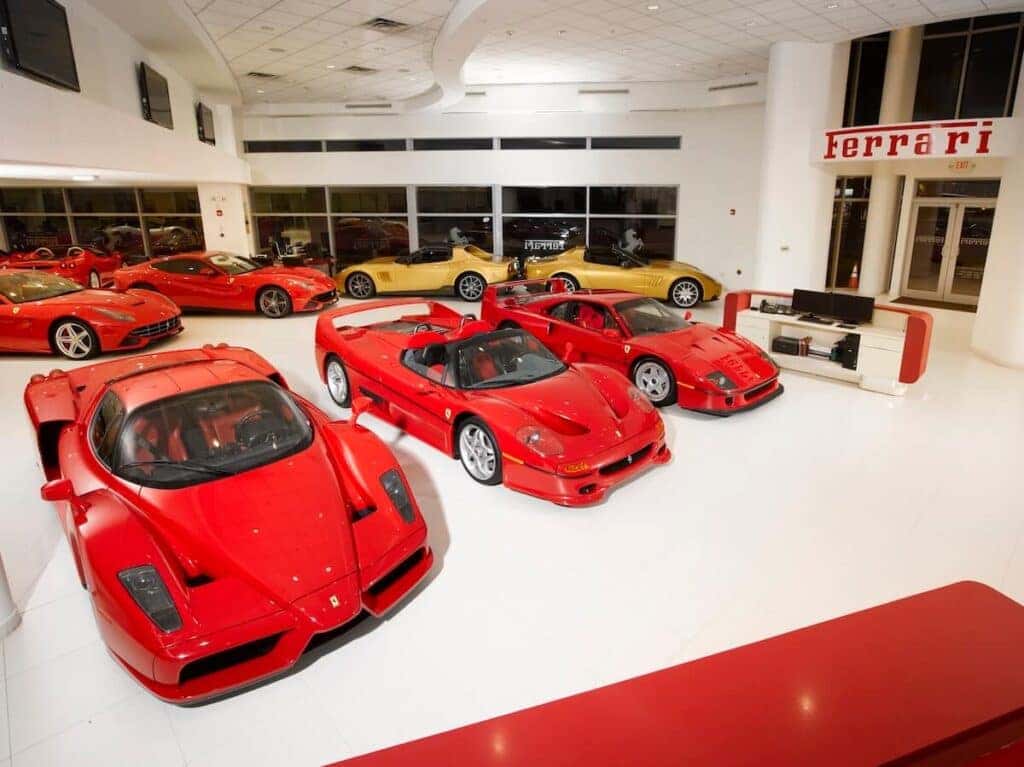
Most Enzos trade between $4 million and $8 million, with exceptional examples reaching $9 million to $12 million or more. Value depends on delivery mileage, original paint, documented history, and Ferrari Classiche certification.
400 in total — 399 production cars plus a 400th built as a gift for Pope John Paul II and later auctioned for charity.
The Ferrari Enzo was designed by Ken Okuyama at Pininfarina. Its aggressive styling was heavily influenced by Formula 1 aerodynamics and Ferrari’s early-2000s motorsport development.
No. The Ferrari Enzo used a 6-speed automated manual F1-style paddle-shift transmission rather than a traditional gated manual gearbox.
Ferrari named the Enzo in honor of company founder Enzo Ferrari. It was one of the few Ferrari road cars officially named directly after him.
The Enzo combined Formula 1-derived technology, a naturally aspirated V12, and a 400-car production run into one of Ferrari’s most iconic hypercars. Named after the founder himself, it is the fourth car in Ferrari’s Big 6 halo lineage and the one that introduced paddle-shift, active aero, and carbon-ceramic brakes to a Ferrari flagship
Yes. The Ferrari Enzo was heavily influenced by Ferrari’s Formula 1 program and introduced race-inspired technology including paddle-shift transmission, carbon-ceramic brakes, and advanced aerodynamics.
Yes. The FXX is a track-only development of the Enzo with an enlarged 6.3-liter V12, built in a run of 30 and maintained by Ferrari rather than its owners. It launched Ferrari’s XX client programme.
Mechanically they share a carbon tub and V12, but the MC12 is longer, wider, and detuned to 630 hp. Ferrari owned Maserati at the time and built 50 road cars purely to homologate the race car.
Yes. Seven-time Formula 1 World Champion Michael Schumacher played a role in testing and developing the Ferrari Enzo during Ferrari’s dominant Formula 1 era.
Ferrari built a 400th Enzo beyond the official 399-car run and presented it to Pope John Paul II in 2005, with a handwritten dedication from chairman Luca di Montezemolo beneath the front lid. It was later auctioned to benefit victims of the 2004 Indian Ocean tsunami.
The Enzo is the hinge between the analog flagships and the electrified ones.
From 1960s competition berlinettas to the latest hybrid flagships, our model showcase covers the cars that built the marque.
Only 400 were built, and Ferrari chose every original buyer by invitation. Official Ferrari Dealer and Classiche-authorized workshop, serving collectors nationwide.