
Home > Blog > Ferrari Model Showcase > Ferrari F355: Specs, Price & the Last Analog Ferrari V8
Share this post:
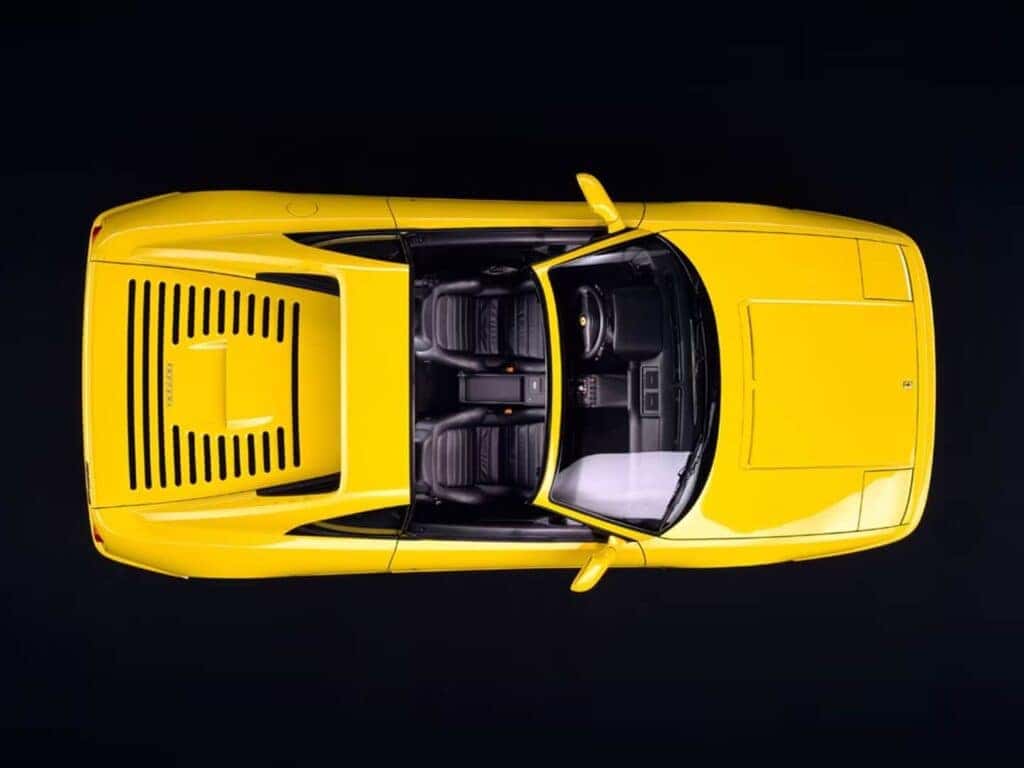
The F355 is a mid-engine V8 sports car built between 1994 and 1999 in three body styles — Berlinetta, GTS, and Spider. It replaced the 348 and was replaced by the 360 Modena.
The name is arithmetic. 3.5 liters, 5 valves per cylinder — the first Ferrari road car engine with that head design, and the reason it makes the power it does. The 360 Modena that followed dropped the valve count and named itself for displacement alone.
It is also the last Ferrari V8 built on a steel chassis. The 360 moved to aluminum, and the character of the cars moved with it.
The F355 was not a facelift. Ferrari changed the engine, the gearbox, the suspension, and the underbody, and the numbers moved accordingly.
| Category | Specification |
|---|---|
| Years | 1994–1999 |
| Engine | 3.5L 90° V8, 5 valves/cyl |
| Horsepower | 375 hp @ 8,250 rpm |
| Torque | 268 lb-ft @ 6,000 rpm |
| Transmission | 6-Speed Manual (F1 from 1997) |
| Redline | 8,500 rpm |
| 0–60 mph | ~4.6 sec |
| Top Speed | 183 mph |
| Dry Weight | ~2,976 lb |
The horsepower figure is the headline. The more telling one is 107 hp per liter — a specific output no naturally aspirated production car had reached before, and seventy-five more horsepower than the 348 made from an engine only 91cc smaller.
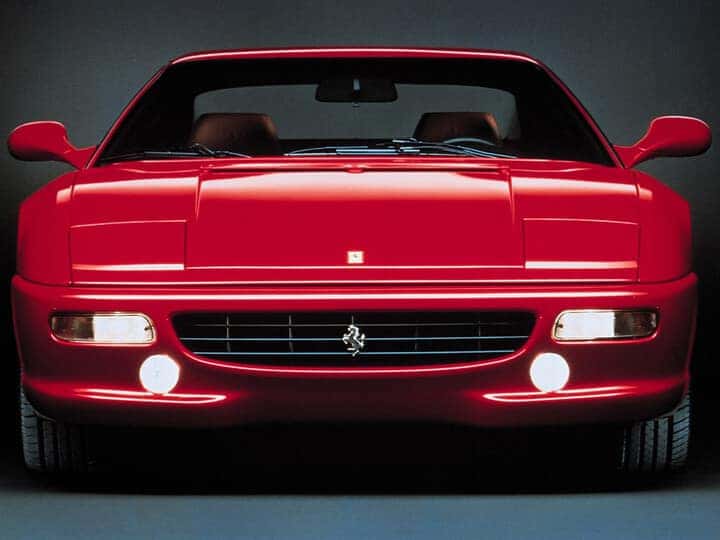
Ferrari’s internal code for the engine is F129B, and it runs three intake valves and two exhaust valves per cylinder. More valve area means more air, and more air at 8,250 rpm is where the 375 hp comes from.
Ferrari had used five-valve heads in Formula 1. The F355 was the first time the architecture reached a customer car, and it arrived with titanium connecting rods and a dry-sump oiling system.
The other half of the engineering story is underneath. The F355 has a fully flat floor and a rear diffuser, developed in the wind tunnel — the first Ferrari road car to generate downforce rather than lift.
The F355 sits on a fault line. It is the last Ferrari V8 sold primarily with a gated manual, and it is the car that introduced the technology that ended them.
Ferrari built the future and the past into the same model. Twenty-five years later, the market pays a premium for the past.
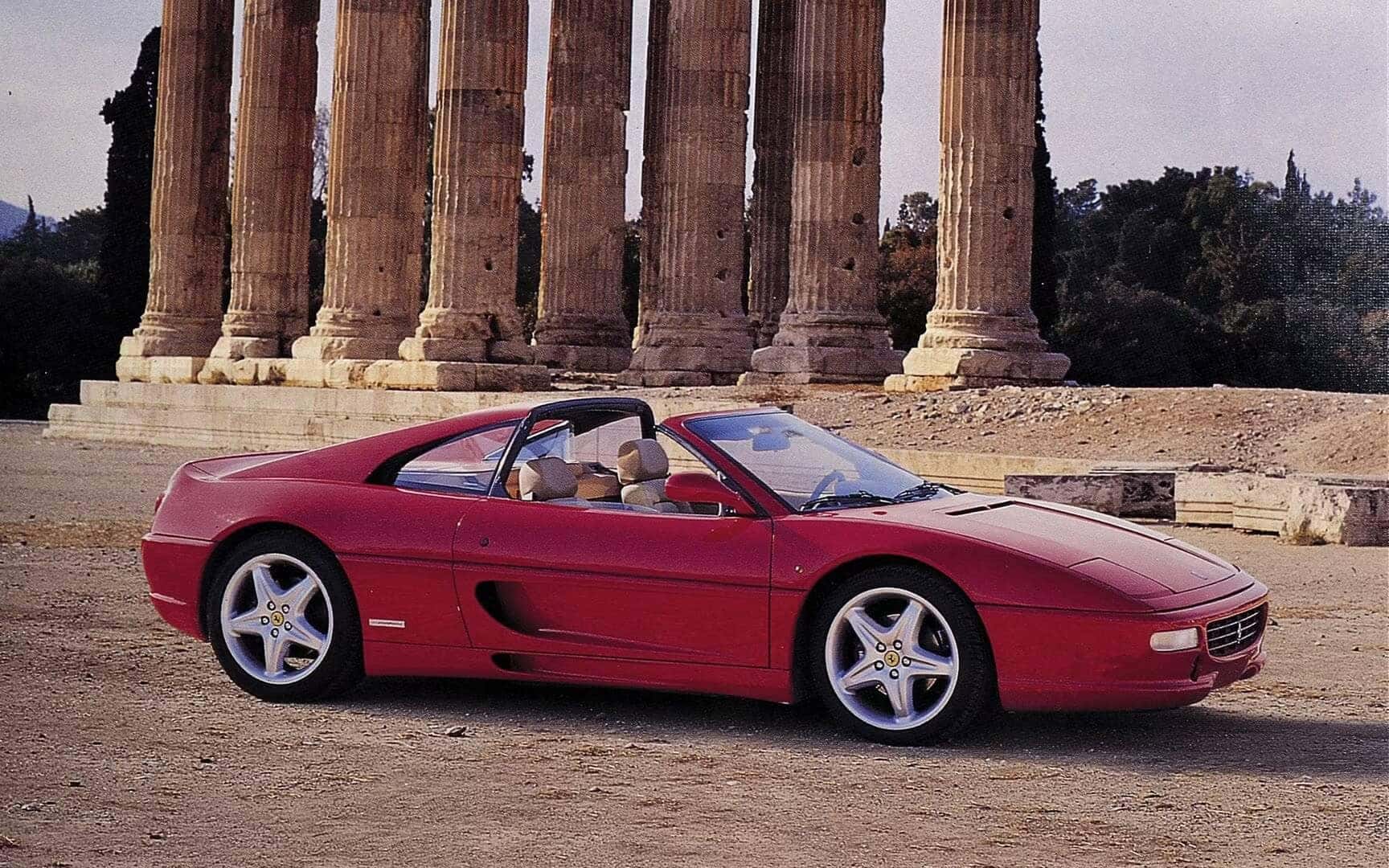
The phrase gets used loosely, so it is worth being precise about what it means here.
The F355 has hydraulic steering, no traction control, a steel chassis, and a gated manual as standard fitment. The 360 that followed introduced an aluminum spaceframe and ASR, and the F1 gearbox went from novelty to majority.
One correction worth making: the F355 was not the last Ferrari V8 offered with a gated manual. The F430 held that distinction, and the 458 dropped the manual entirely. The F355’s claim is about construction and default specification, not about being last off the line.
That distinction matters when you are shopping. A gated F430 is a manual Ferrari. A gated F355 is a manual Ferrari built before the electronics arrived.
Pininfarina styled the F355 under Lorenzo Ramaciotti’s studio, and the brief was to clean up the 348 rather than replace its proportions.
The Spider’s electric roof was the first on a Ferrari, and it works better than its reputation suggests.
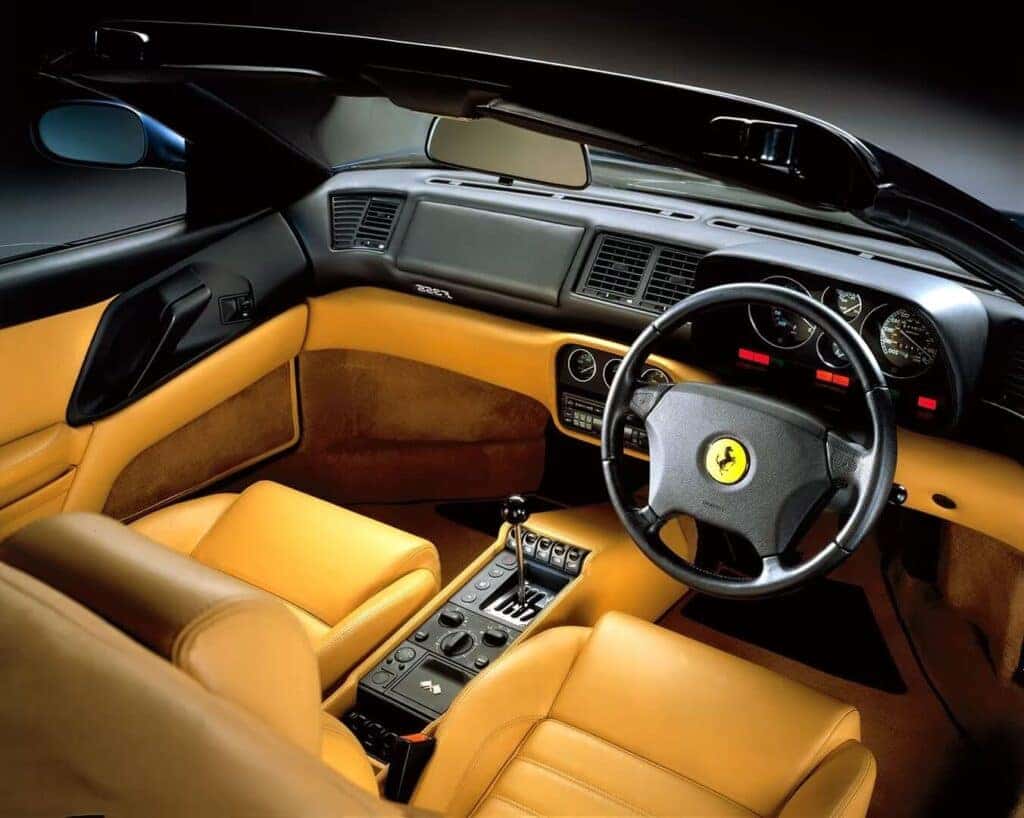
| Category | Specification |
|---|---|
| Gearbox | Open metal gate, six speeds, aluminum ball shifter |
| Instruments | Yellow-faced tach with an 8,500 rpm redline |
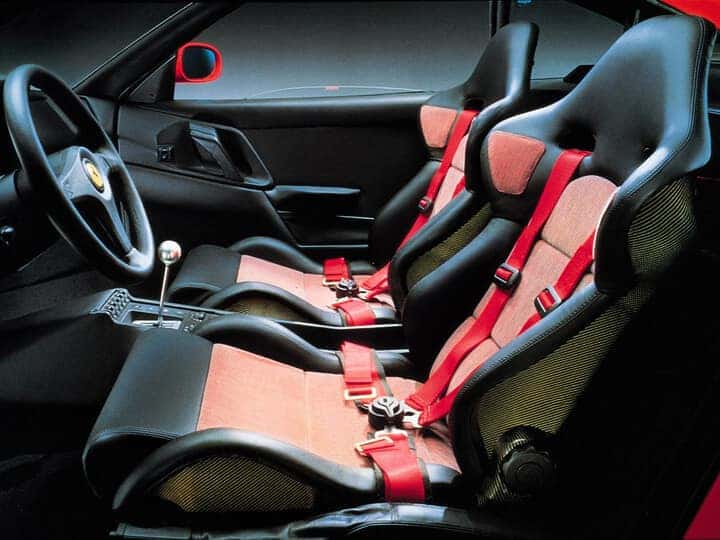
| Seats | Connolly leather buckets; carbon-shell seats were a later option |
| Steering Wheel | Momo three-spoke, hydraulically assisted rack |
| Pedals | Drilled aluminum, floor-hinged throttle |
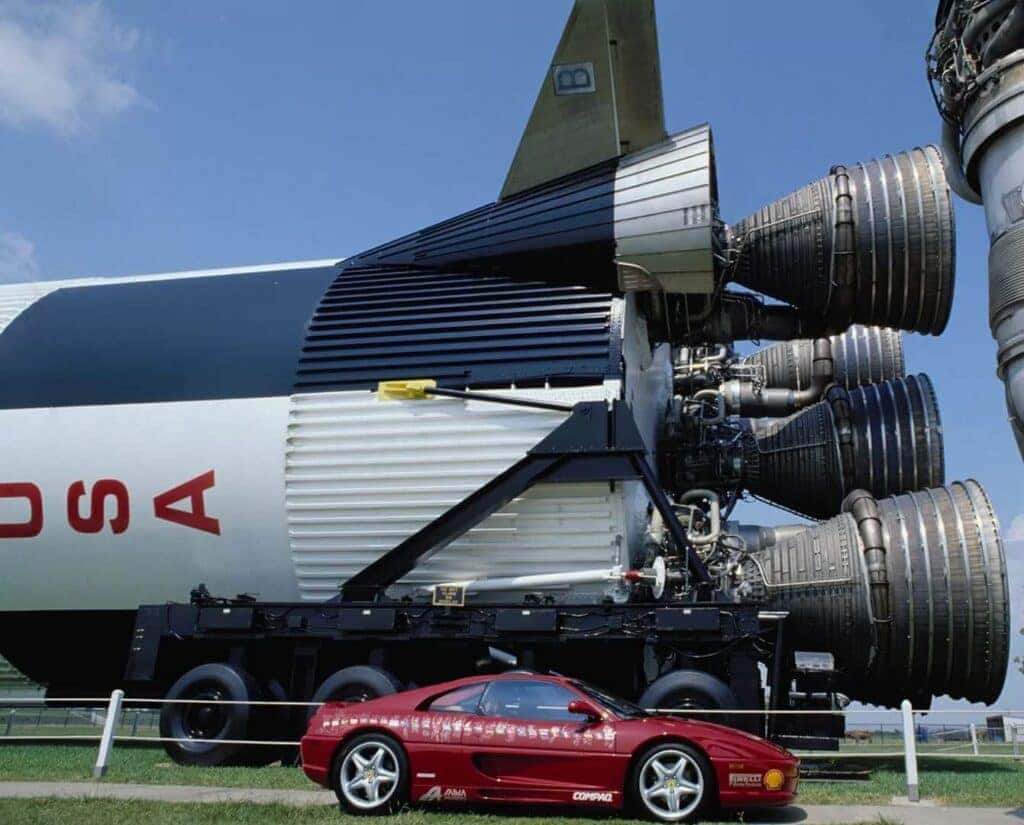
Ferrari built roughly 11,273 F355s across five model years — more than the 348 before it, and enough that the model still trades regularly rather than sitting in collections.
| Variant | Years | Production |
|---|---|---|
| Berlinetta | 1994–1999 | ~4,871 |
| GTS | 1994–1999 | ~2,577 |
| Spider | 1995–1999 | ~3,717 |
| Challenge | 1995–1999 | ~108 |
| Total | 1994–1999 | ~11,273 |
Registries differ at the margins depending on whether pre-production prototypes are counted. The three body-style figures are consistent across sources.
The 104 Serie Fiorano cars are not a separate line — they were Spiders built with a final-year option package, and they sit inside the 3,717 figure above.
The Serie Fiorano is the one collectors chase — a final-year 1999 run of 104 Spiders built to close out F355 production.
Ferrari planned 100 cars, all for the United States, and built four more outside that allocation — three for Europe and one for South Africa, none with the numbered plaque.
The transmission split is what the market watches. Of the 100 US cars, 74 took the F1 paddle-shift and 26 the six-speed manual. That combination — the rarest variant with the gearbox collectors now want — set the model’s public auction record in 2026.
The GTS takes a removable targa panel and stores it behind the seats. The Spider takes a powered soft top and gives up a little structural rigidity for it.
Berlinettas have historically led on value, GTS cars have closed most of the gap, and Spiders trade slightly behind both. The spread is narrower than it is on most Ferraris of the period.
A manual F355 Berlinetta typically trades between $130,000 and $275,000, with condition and vehicle options accounting for most of the range. F1 paddle-shift models drop the floor further, occasionally dipping below $100,000.
For years the F355 was the cheap way into a mid-engine Ferrari. That has ended. The gated manual is now the price driver, and the market has separated the two gearboxes decisively.
| Variant | Value |
|---|---|
| Berlinetta — Manual, Average | ~$185,000 |
| Berlinetta — Manual, Range | ~$130,000 – $275,000 |
| GTS — Manual, Average | ~$175,000 |
| Spider — Manual, Average | ~$155,000 |
| F1-Equipped Cars | Typically 20–30% below comparable manuals |
| Serie Fiorano | Consistent premium; few public sales |
A 1999 F355 Spider Serie Fiorano — one of just 26 built with the six-speed manual — sold at Gooding & Company’s Monterey auction in August 2026 against a $300,000–$400,000 estimate. It took the record from a yellow Serie Fiorano that made $495,000 earlier the same year.
The standard road-car record is $355,355, paid on Bring a Trailer for a Rosso Corsa 1997 Berlinetta over tan leather with 17,000 miles — gated six-speed, early dual-ECU Motronic 2.7, and a $9,000 engine-out belt service completed weeks before the sale. Bidders stopped deliberately at $355,355, a salute to the model name.
Two things carried all three cars. The gated manual is the obvious one, and the gap between a manual F355 and an equivalent F1 car now runs 20–30% — a premium that did not exist a decade ago, when the paddle-shift was seen as the desirable spec.
If you own an F355 or another collector Ferrari, our specialists can value your car or discuss consignment.
The F355 is a well-supported car with a small number of expensive, well-documented weak points. None of them are mysteries, and all of them are priced into a good pre-purchase inspection.
Ferrari of Fort Lauderdale is a factory-authorized dealer with a dedicated vintage Ferrari service department and an on-site Ferrari Classiche program.
The F355 opened the high-revving naturally aspirated V8 era. The 458 Italia closed it — the last Ferrari V8 without a turbocharger, and the last with an engine that pulls to 9,000 rpm.
| Feature | F355 (1994–1999) | 458 Italia (2009–2015) |
|---|---|---|
| Engine | 3.5L V8, 5 valves/cyl | 4.5L V8, naturally aspirated |
| Horsepower | 375 hp @ 8,250 rpm | 562 hp @ 9,000 rpm |
| Transmission | 6-Speed Manual / F1 | 7-Speed Dual-Clutch |
| Chassis | Steel | Aluminum |
| 0–60 mph | ~4.6 sec | ~3.0 sec |
| Manual Available | Yes | No |
Scroll for more →
Fifteen years separate them and the engineering is unrecognizable, but the brief is identical: a mid-engine V8 that does its best work at the top of the tachometer. The 488 that followed added turbochargers and ended the argument.
3.5 liters and 5 valves per cylinder. It is the only Ferrari model name that describes the cylinder head.
It is one of the better ones. Parts supply is good, the specialist network knows the car, and the failure points are documented. The major service is the cost to plan for.
Manual Berlinettas average around $135,000, with GTS cars close behind and Spiders slightly lower. F1-equipped cars trade 20–30% below comparable manuals.
The manual, if the budget allows. It drives better, it has fewer expensive systems, and the market has priced it accordingly.
Roughly 11,165 across the three body styles — about 4,871 Berlinettas, 2,577 GTS, and 3,717 Spiders.
A timing belt service performed with the engine removed, on roughly a five-year interval. It is the defining maintenance item on the car and the first thing to check in a service file.
Yes. The 1997 F355 F1 introduced the first electrohydraulic paddle-shift gearbox in a production road car, derived from Ferrari’s Formula 1 program.
The 360 Modena in 1999, which moved to an aluminum chassis and made the F1 gearbox the volume specification.
It is the last Ferrari V8 with a steel chassis, no traction control, and a manual as standard. The F430 was the last V8 offered with a gated manual.
The F355 is the entry point to a line that runs to the 458.
Ferrari of Fort Lauderdale proudly represents Ferrari in Broward County, Greater South Florida, and across the United States.