BEYOND IMAGINATION

The SF90 Spider:
AN OPEN-AIR SUPERCAR

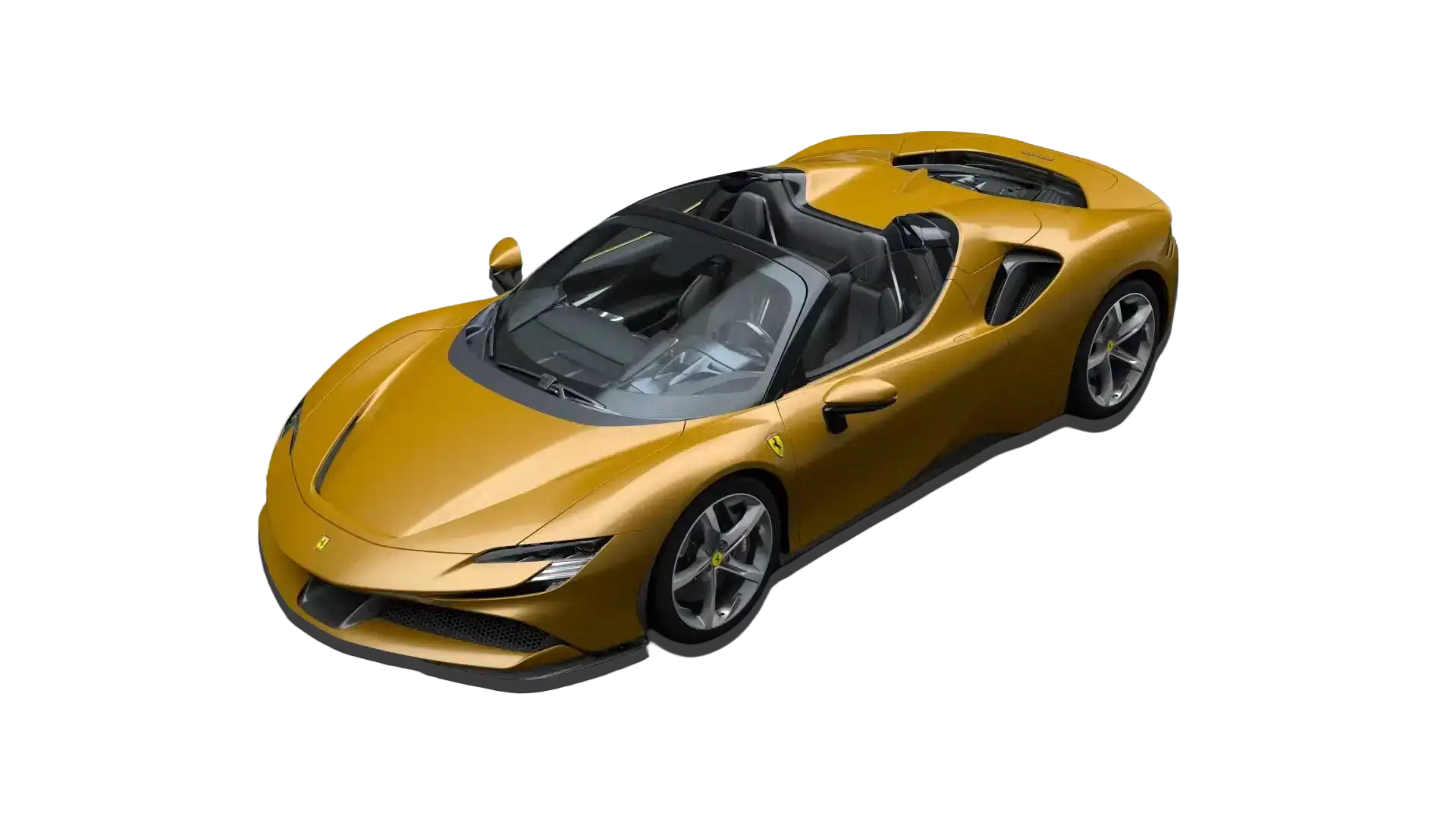
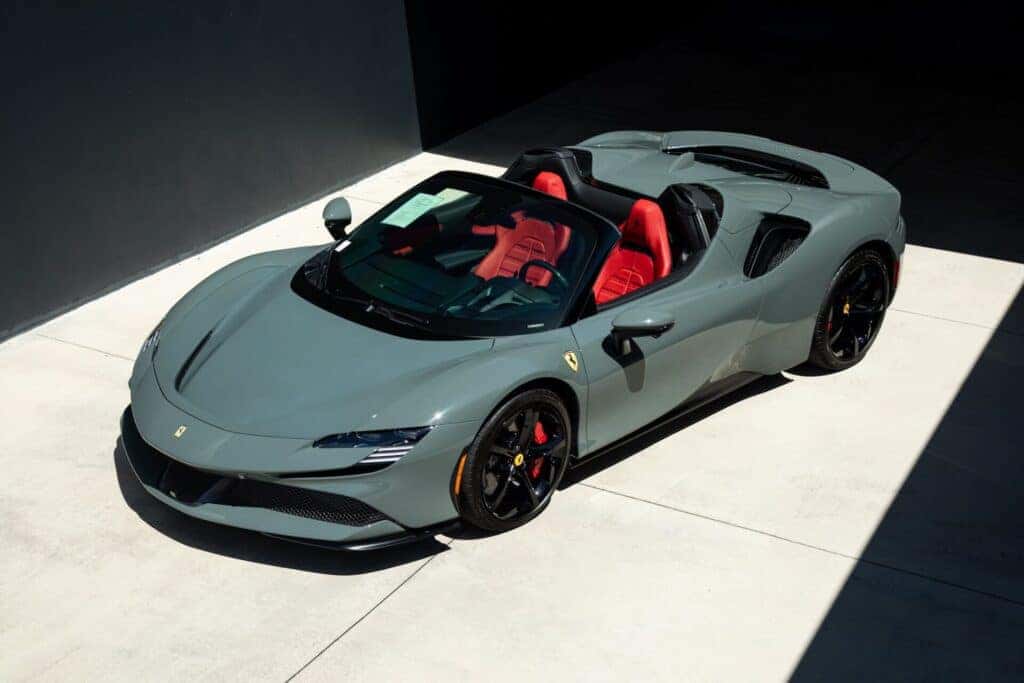
As the Prancing Horse’s first production plug-in hybrid spider, the SF90 Spider sets new performance and innovation benchmarks not only for the marque’s range, but for the entire sports car sector. The new convertible has the same extreme supercar specification and record-breaking performance as the SF90 Stradale yet also adds further driving pleasure and versatility to the mix, thanks to the latest iteration of Ferrari’s signature Retractable Hard Top architecture. This makes the SF90 Spider the ideal car for owners that demand the very pinnacle of Ferrari technology, but still want the thrill and versatility of open-top driving.


1
Powertrain

1,000 CV PLUG-IN HYBRID SYSTEM

V 8
Engine
0 kW
eDrive power
0 sec
0-100 km/h
0 cv
Maximum power

The SF90 Spider has plug-in hybrid architecture in which the internal combustion engine is integrated with two electric motors at the front, which comprise the RAC-e (Cornering Angle Regulator, Electric) system, and one at the rear derived from and named after a Prancing Horse Formula 1 innovation, the MGUK (Motor Generator Unit, Kinetic). The synergy between the internal combustion engine and the electric motors unleashes a maximum of 1,000 cv and puts the SF90 Spider not only at the very top of its category but also the Maranello range.

2
Aerodynamics

An Open-top powerhouse of innovation

3
Design

Sportiness Meets Freedom

The starting point for the SF90 Spider design was to ensure it remained as faithful as possible to the SF90 Stradale’s signature styling. The Ferrari Styling Centre’s meticulous crafting of the tonneau area has integrated it seamlessly with the rest of the car, an achievement that is even more astonishing because the V8 is still clearly visible through the engine bay cover despite the inclusion of the RHT stowage. The V8 thus remains the star of the show and very much on display whether the RHT is deployed or retracted.

THE COCKPIT

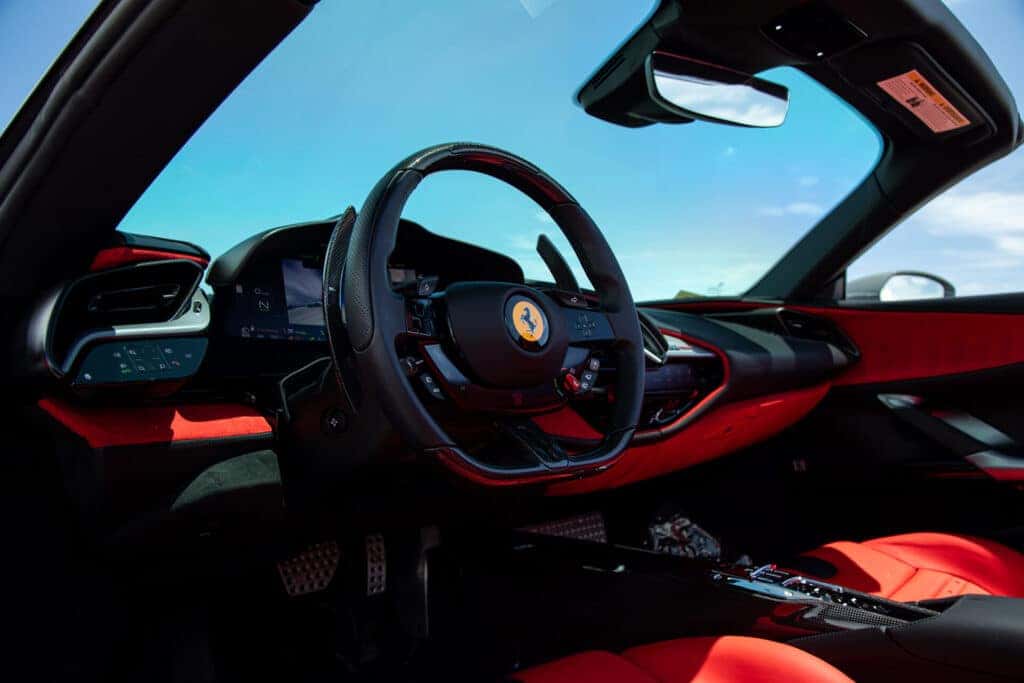
The track-derived “eyes on the road, hands on the steering wheel” philosophy has shaped both the ergonomics and styling of the interior, resulting in an innovative HMI concept that puts control of virtually every aspect of the car at the driver’s fingertips.

The central instrument cluster is entirely digital, featuring a 16″ curved HD screen that can be fully configured using the steering-wheel controls. A touchpad on the right-hand spoke allows the driver to navigate the central display, while voice and cruise controls are positioned on the left. A new cruise control rotary switch, also derived directly from Formula 1, further reinforces the racing-inspired approach.

On the central tunnel, the automatic gearbox controls are operated through a grille-style feature inspired by Ferrari’s iconic manual gearshift gate.


4
Dynamics

Intelligent Traction Control

5
Technical Specifications

Class Leading Performance

Performance
Engine 4.0 Liter Twin-Turbo V8
Hybrid System 3 Electric Motors
Combined Power 986 hp
Torque 590 lb-ft
0–100 km/h 2.5 seconds
Top Speed 340 km/h
Engineering
Drivetrain AWD PHEV
Transmission 8-Speed DCT
EV Range 25 km
Battery 7.9 kWh
Weight 1,670 kg
Dimensions
Length 4,704 mm
Width 1,973 mm
Height 1,191 mm
Wheelbase 2,649 mm
6
Gallery

Beyond Imagination

Experience the Ferrari SF90 Spider

Discover available SF90 models and connect with our Ferrari specialists to begin your ownership journey.

Model - SF90 Spider Contact Form

  • This field is for validation purposes and should be left unchanged.
1
Powertrain

The Ultimate Expression Of Maranello's Legendary V8

Play Video

Thanks to a massive 780 cv (and 195 cv/l specific power output), the SF90 Spider’s engine is at the very top of Ferrari’s V8 range. To deliver this extraordinary result, Ferrari’s engineers completely redesigned the intake and exhaust systems. The ducts are now all horizontally lined up at engine head height, the turbo charger assembly has been lowered, and the exhaust line is higher in the new configuration. This rationalisation also produced both a lower centre of gravity and a reduction in overall weight thanks to the use of Inconel for the exhaust manifold.

NEW CONTROL LOGIC

The SF90 Spider features an eManettino selector alongside the traditional Manettino, putting control of the hybrid power system at the driver’s fingertips with four distinct modes:

eDrive — ICE off, fully electric via the front axle (up to 25 km range)
Hybrid — the system decides when to run or cut the ICE, conserving battery
Performance — ICE stays on to keep the battery charged and power on demand
Qualify — all 1,000 cv unleashed, electric motors at full 162kW potential

Play Video
Play Video

Silent Power: eDrive

The SF90 Spider’s eDrive mode transforms the car into a fully electric vehicle at the turn of a dial. With the internal combustion engine completely shut off, traction is handed entirely to the electric front axle — delivering silent, zero-emission driving with up to 25 km of range.

It’s a different side of the SF90 experience: the same striking design and presence, but with a quieter, smoother character suited to city driving, residential neighborhoods, or early morning departures. Despite running on electric power alone, the front axle still delivers immediate torque and responsive handling, making it feel unmistakably Ferrari even without the V8.

Shut-off Gurney

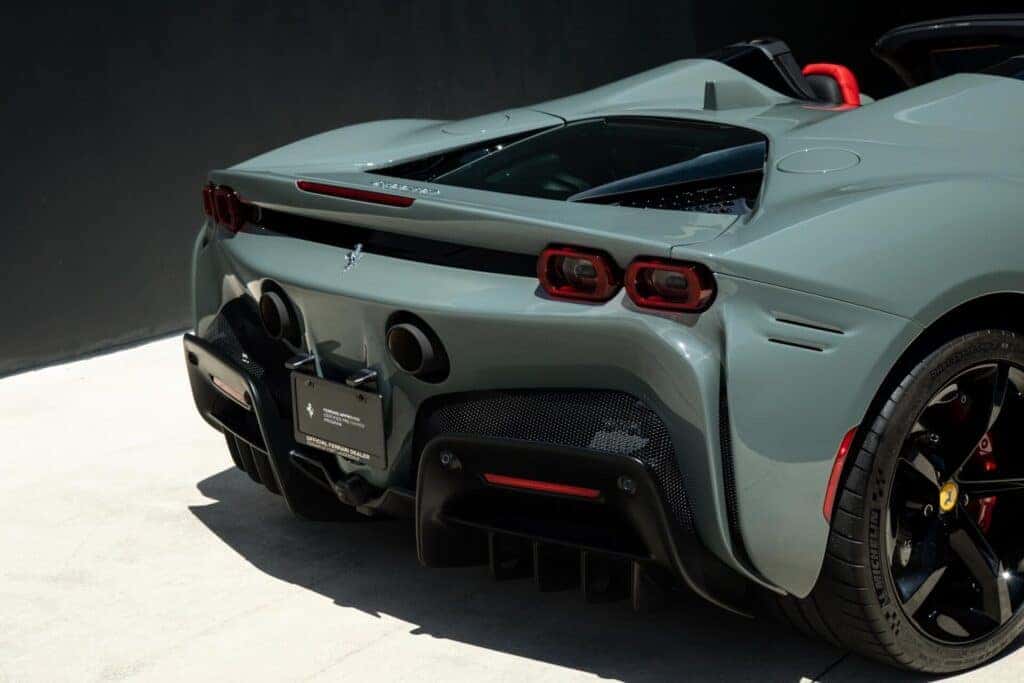
The SF90 Spider’s engine cover has been kept extremely low to improve the interaction between the flows over and under the body, and thus minimise drag. 

The end section of the engine cover features a suspended wing divided in two sections: one fixed, which incorporates the third brake light, and one mobile with a wedge-shaped front area.

The latter has been dubbed the shut-off Gurney, a patented active system located at the rear of the car which regulates the air flow over the upper body, reducing drag at high speeds with low lateral dynamics loads and increasing downforce in corners, under braking and during changes of direction. 

Forged wheels

Specific aerodynamic research went into the geometry of the forged wheels which are made using a construction technology that allows greater freedom when it comes to aerodynamic solutions.  The specific geometry of the wheels incorporate radial elements on the outer channel which are equally spaced between the spokes and designed to act as wing profiles.

The geometry of these profiles mean that the wheel works like a rotor blade, very efficiently managing the flows from inside the wheelarch and guaranteeing two main effects: air evacuation from wheel arch is boosted; the flow exiting the wheel rim is lined up with the longitudinal flow running along the sides.

Vortex Generator

Rear downforce is balanced at the front of the car by a complex and optimised system of vortex generators.

Although this is not its very first appearance on a Ferrari sports car, the system has been honed to the maximum on the SF90 Spider: the front section of the chassis has been raised 15 mm compared to the central section of the chassis at the point where the vortex generators are located, thus increasing the amount of air channelled towards them and boosting their effect.  

The front bumper is divided into two sections that have specific wing functions. Between the upper section and the bonnet is a pronounced indent that locally compresses the flow. This feature, together with the two diffusers ahead of the front wheels, contributes to generating downforce over the front axle. 

3
Design

Sculpted Beyond Convention

The starting point for the SF90 Spider design was to ensure it remained as faithful as possible to the SF90 Stradale’s signature styling. The Ferrari Styling Centre’s meticulous crafting of the tonneau area has integrated it seamlessly with the rest of the car, an achievement that is even more astonishing because the V8 is still clearly visible through the engine bay cover despite the inclusion of the RHT stowage. The V8 thus remains the star of the show and very much on display whether the RHT is deployed or retracted.

Play Video
4
Dynamics

ELECTRONIC SIDE SLIP CONTROL

The existing dynamic control system has been further enhanced. Now referred to as the electronic Side Slip Control (eSSC) system, it verifies the car’s dynamic status in real time. Based on that information, it controls vehicle stability by delivering torque independently via the front electric engines to the inside and outside wheel (Torque Vectoring), significantly improving traction coming out of corners and making it much simpler and more intuitive to drive on the limit with confidence.

Play Video

Select Language

Ferrari of Fort Lauderdale 26.199591, -80.1117836.